

Securing a reliable income stream during retirement is a primary concern for millions of Americans, yet finding the right vehicle requires more than just a glance at interest rates. According to recent industry data, fixed annuities have seen a surge in popularity among pre-retirees seeking to lock in guaranteed rates before market volatility impacts their nest eggs. This guide explores how to effectively compare Modified Guaranteed Annuities (MGAs) and traditional fixed annuities within the Colorado market, ensuring you make informed decisions that align with your long-term financial goals.
Understanding MYGA vs. Fixed Annuities
Before diving into rate comparisons, it is essential to define the products you are evaluating. A Modified Guaranteed Annuity (MYGA) is a type of fixed annuity that offers a fixed interest rate for a specific term, similar to a certificate of deposit (CD), but with potential tax-deferred growth. MYGAs are distinct because they often offer higher initial rates than traditional bank CDs, making them attractive for conservative investors.
Traditional fixed annuities, on the other hand, may offer a guaranteed minimum interest rate that can adjust periodically based on the insurer's performance. While MYGAs provide a locked-in rate for the entire term, traditional fixed annuities might offer more flexibility in how interest is credited. Understanding this difference is critical when comparing rates, as a higher initial rate on a MYGA might not always yield the best long-term result if your financial needs change.
For individuals in Colorado, these products serve as a buffer against market downturns. They provide a predictable income floor, which is particularly valuable in an economic landscape where inflation and interest rate fluctuations can disrupt retirement plans. By choosing the right product, you can ensure that a portion of your portfolio remains stable regardless of broader economic trends.
Colorado Market Dynamics and Rates
The Colorado insurance market offers a diverse range of annuity providers, each with its own risk appetite and rate structure. Interest rates for fixed annuities are heavily influenced by the broader bond market, particularly the 10-year Treasury yield. When Treasury yields rise, annuity rates typically follow, offering better returns for new buyers. Conversely, when yields fall, annuity rates drop, making timing crucial for Colorado residents looking to lock in rates.
Colorado residents often benefit from a competitive local market. Independent producers like Rachel Reynolds have access to a wide network of top-rated insurance carriers, allowing for side-by-side comparisons that are not always available to the general public. This access is vital because rate differences between carriers can be significant, sometimes exceeding 1% or more on the same product type.
Furthermore, the demographic profile of Colorado, with its mix of pre-retirees and retirees, creates a unique demand for flexible annuity solutions. Many residents are looking for products that offer both safety and some liquidity, which is why MYGAs with surrender period flexibility are gaining traction. Understanding these local dynamics helps in selecting a product that not only offers a good rate but also aligns with the lifestyle and financial flexibility needs of Coloradoans.
How to Compare Rates Effectively
Comparing annuity rates requires more than just looking at the headline interest rate. You must consider the surrender period, the renewal rates, and the financial strength of the issuing carrier. A common mistake is focusing solely on the initial rate without considering what happens after the term ends. If the renewal rate is low, the long-term value of the annuity may be diminished.
Here is a structured approach to comparing MYGAs and fixed annuities:
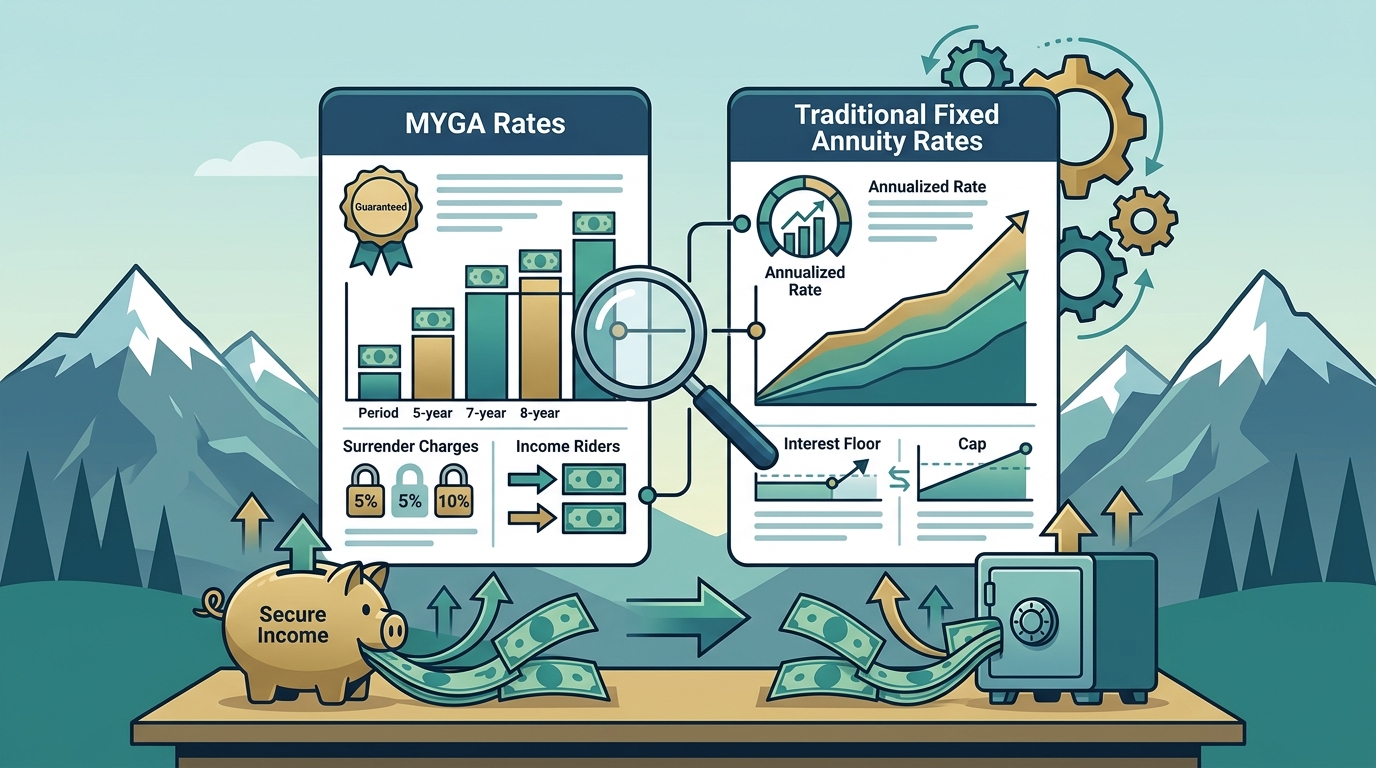
| Feature | MYGA (Modified Guaranteed Annuity) | Traditional Fixed Annuity |
|---|---|---|
| Interest Rate | Fixed for the entire term | May adjust periodically |
| Surrender Period | Typically 3-10 years | Varies by carrier |
| Penalty for Early Withdrawal | Yes, declines over time | Yes, declines over time |
| Best For | Locking in rates for a set period | Long-term income needs |
When evaluating these options, it is also important to look at the carrier's A.M. Best rating. A high rate is meaningless if the carrier is not financially stable. Colorado residents should prioritize carriers with strong financial backing to ensure their guaranteed income is secure. Additionally, consider the surrender charge schedule. If you anticipate needing access to your funds before the term ends, a MYGA with a shorter surrender period might be more appropriate, even if the initial rate is slightly lower.
Key Features and Riders
Beyond the base rate, the features attached to an annuity can significantly impact its value. One of the most valuable features is the living benefit rider, which can provide guaranteed income regardless of market performance. For those concerned about long-term care costs, a long-term care rider can be a critical addition to a fixed annuity strategy.
Another important consideration is the death benefit. Some annuities offer a return of premium feature, ensuring that if you pass away during the surrender period, your beneficiaries receive the full amount invested. This can be particularly important for Colorado families who want to leave a legacy while also securing their own retirement income.
Rachel Reynolds specializes in helping clients navigate these complex features. By analyzing your specific goals, she can identify which riders add value and which are unnecessary costs. For example, if you have other sources of long-term care insurance, a rider on your annuity might be redundant. Conversely, if you lack other coverage, this feature could be invaluable. Understanding these nuances is key to optimizing your annuity strategy.
Tax Implications for Colorado Residents
One of the primary advantages of fixed annuities is tax-deferred growth. You do not pay taxes on the interest earned until you withdraw the funds. This can be particularly beneficial for Colorado residents who are in higher tax brackets and want to minimize their current tax liability. However, withdrawals before age 59½ may be subject to a 10% IRS penalty, so it is important to plan for liquidity needs.
Colorado does not tax Social Security benefits, but it does tax other forms of retirement income. Understanding how annuity withdrawals are taxed in Colorado is essential for effective retirement planning. While the state does not have a specific annuity tax, the income is treated as ordinary income. This means that the tax rate you pay upon withdrawal will depend on your total taxable income for that year.
Strategic withdrawal planning can help minimize your tax burden. For instance, taking smaller withdrawals in years when your income is lower can keep you in a lower tax bracket. Additionally, considering the interaction between annuity income and other retirement accounts, such as IRAs and 401(k)s, is crucial for a holistic tax strategy. Consulting with a tax professional can provide personalized advice based on your specific financial situation.
Key Takeaways
- MYGAs vs. CDs: MYGAs often offer higher interest rates than comparable bank CDs, making them a strong alternative for conservative investors.
- Rate Locking: Fixed annuities allow you to lock in interest rates for a specific period, protecting you from future rate declines.
- Colorado Market: The Colorado market offers diverse options, and working with an independent producer provides access to multiple carriers.
- Financial Strength: Always check the A.M. Best rating of the insurance carrier to ensure the security of your investment.
- Surrender Periods: Understand the surrender charge schedule to avoid penalties if you need access to your funds early.
- Tax Deferral: Annuities offer tax-deferred growth, which can be beneficial for high-income earners in Colorado.
- Professional Guidance: An independent producer can help you compare rates and features across multiple carriers to find the best fit.
Frequently Asked Questions
What is the difference between a MYGA and a traditional fixed annuity?
A MYGA offers a fixed interest rate for the entire term, similar to a CD, while a traditional fixed annuity may have interest rates that adjust periodically based on the insurer's performance. MYGAs are often chosen for their rate stability.
Are MYGAs safe for Colorado residents?
MYGAs are issued by insurance companies and are backed by the claims-paying ability of the insurer. They are not FDIC insured, but many carriers have strong financial ratings. It is important to choose a highly rated carrier for safety.
How do I compare annuity rates in Colorado?
You can compare rates by working with an independent insurance producer who has access to multiple carriers. This allows for a side-by-side comparison of rates, surrender periods, and features that is not typically available to the public.
What happens if I need to withdraw money from a MYGA early?
If you withdraw money from a MYGA before the end of the surrender period, you will likely face a surrender charge. These charges typically decrease over time. It is important to plan for liquidity needs before investing.
Do I have to pay taxes on MYGA interest?
Interest earned on a MYGA is tax-deferred until you withdraw it. Withdrawals are taxed as ordinary income. Additionally, withdrawals before age 59½ may be subject to a 10% IRS penalty.
Can I use a MYGA for college funding?
Yes, some individuals use overfunded annuities to supplement college funding. However, it is important to consider the tax implications and surrender charges. It may not be the most efficient vehicle compared to a 529 plan for some families.
How long does a MYGA term typically last?
MYGA terms typically range from 3 to 10 years. The length of the term can affect the interest rate offered, with longer terms often providing higher rates.
Contact Rachel Reynolds
Comparing MYGA and fixed annuity rates in Colorado requires a nuanced understanding of the market, carrier strength, and your personal financial goals. Rachel Reynolds, as an independent insurance producer, provides the expertise and access needed to navigate this complex landscape. She helps individuals, families, and business owners identify the protection they need and understand the policy before they apply.
If you are ready to explore your options, request a quote today. Rachel can help you explore insurance options based on your goals, responsibilities, and budget. Her approach is straightforward: identify the protection you need and understand the policy before you apply. For more information about her services, visit the About Rachel page or check out the Frequently Asked Questions section.