

Life insurance is primarily designed to provide a death benefit, not solely as an accumulation vehicle. However, the way policies accumulate value and protect beneficiaries varies drastically across the market. According to the Life Insurance Marketing and Research Association, life insurance in force in the United States reached approximately $13.5 trillion in recent years, highlighting the massive scale of this financial sector. Understanding the nuances between term, whole, and universal life insurance is critical for anyone seeking to protect their family's financial future. This guide breaks down the mechanics, costs, and strategic applications of each type to help you choose the right path.
What Is Life Insurance?
Life insurance is a contract between an individual and an insurance company where the insurer promises to pay a designated beneficiary a sum of money upon the death of the insured. This financial safety net ensures that loved ones can maintain their standard of living, pay off debts, and cover final expenses without facing financial ruin. The core purpose is income replacement and legacy planning. For many, it is the most important financial tool available for risk management.
Choosing the right policy depends on your current life stage, budget, and long-term goals. Are you looking for temporary coverage to protect a mortgage? Or do you want a permanent asset that builds cash value for retirement? The answer lies in understanding the three main categories: term, whole, and universal life insurance.
Term Life Insurance: The Foundation
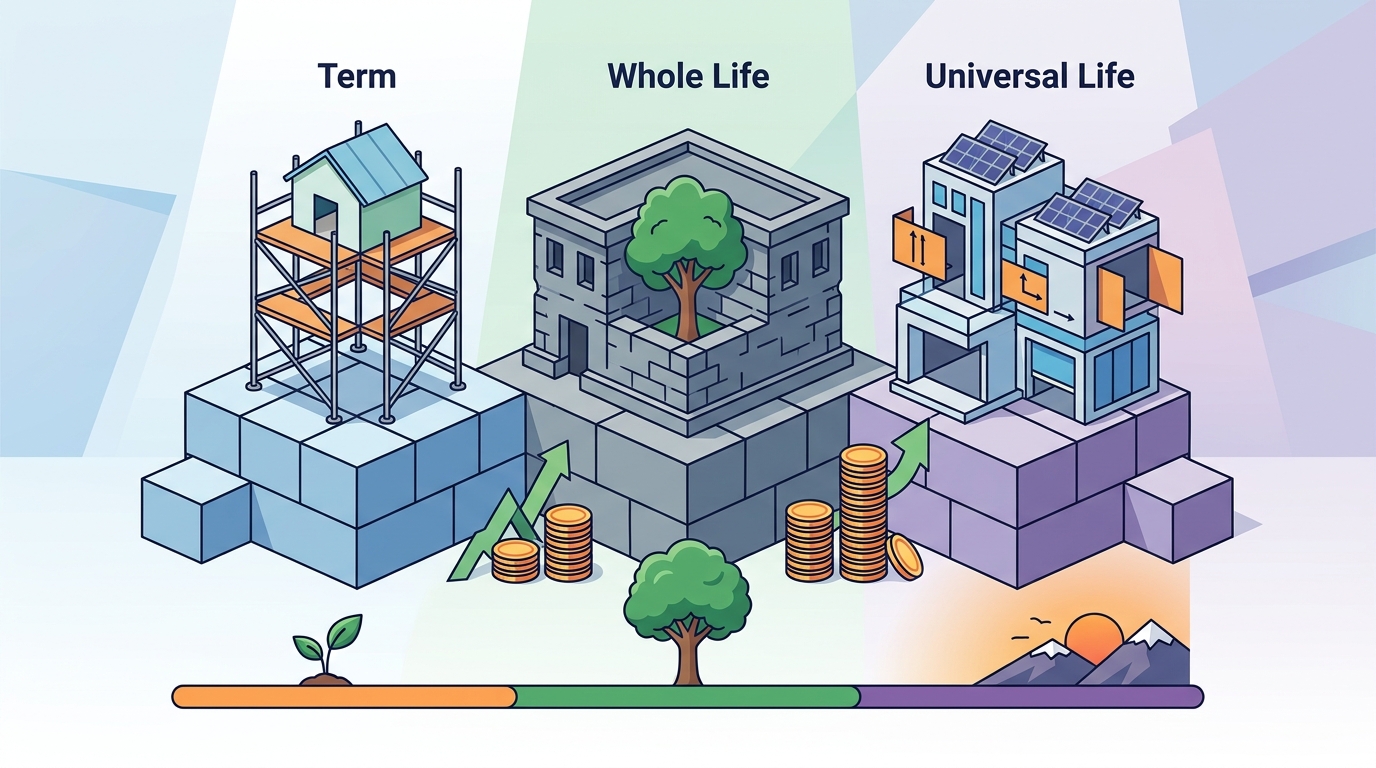
Term life insurance provides death-benefit protection for a selected period, such as 10, 20, or 30 years. It is often an affordable choice for temporary needs and generally does not build cash value. This makes it the most popular form of life insurance for young families and individuals with significant debt obligations.
Income Protection and Debt Coverage
The primary utility of term life is income protection. If you have a mortgage, term life can ensure that your family can keep their home if you pass away. It also covers other debts, such as car loans or credit card balances, preventing these obligations from falling on your spouse or children. According to data from the Federal Reserve, the median household debt in the United States remains high, making debt coverage a critical component of financial planning.
Living-Benefit Term Options
Modern term policies often include riders that allow early access to part of the death benefit after a qualifying chronic, critical, or terminal illness or covered injury. This feature, known as a living benefit rider, adds significant value to a basic term policy. It allows you to use the funds for medical bills or quality of life improvements while you are still alive, providing a safety net even if you do not pass away during the term.
Whole Life Insurance: The Guarantee
Whole life insurance is a type of permanent coverage with scheduled premiums, guaranteed cash value, and a guaranteed death benefit when policy requirements are met. Unlike term insurance, whole life does not expire as long as premiums are paid. It is designed for lifelong protection and wealth accumulation.
Guaranteed Cash Value Growth
One of the defining features of whole life is its predictable cash value growth. The insurance company guarantees a minimum interest rate on the cash value component. This growth is tax-deferred, meaning you do not pay taxes on the gains until you withdraw them. For high-net-worth individuals, this stability is invaluable. It provides a known quantity that can be used for supplemental retirement income or education funding.
Dividends and Policy Performance
Many whole life policies are "participating," meaning they may pay dividends. These dividends are not guaranteed, but they can be used to purchase additional paid-up insurance, reduce premiums, or be taken as cash. Historically, whole life policies have performed well in stable economic environments. However, market volatility can impact the performance of other permanent policies, making the guaranteed nature of whole life attractive for risk-averse investors.
Universal Life Insurance: The Flexibility
Universal life insurance is permanent coverage with flexible premium and death-benefit options. Cash value earns interest under the policy's crediting terms, subject to charges and guarantees. This type of policy bridges the gap between term and whole life by offering both permanent coverage and investment-like flexibility.
Flexible Premiums and Death Benefits
The key advantage of universal life is flexibility. You can adjust your premium payments within certain limits. If you have a financial windfall, you can pay more to boost cash value. If you face financial hardship, you can pay less, provided the cash value is sufficient to cover the cost of insurance. This adaptability makes it suitable for business owners and individuals with irregular income streams.
Indexed Universal Life (IUL)
Indexed universal life is a popular variant where the cash value interest is linked in part to a market index, such as the S&P 500. It does not invest directly in the index, and credits are subject to policy terms such as caps, participation rates, or spreads. This structure offers the potential for higher returns than traditional whole life while providing a floor that protects against market losses. According to industry reports, IUL has seen significant growth in recent years as consumers seek market-linked growth with downside protection.
Comparing Policy Structures
Understanding the differences between these policies is essential for making an informed decision. The table below summarizes the key distinctions.
| Feature | Term Life | Whole Life | Universal Life |
|---|---|---|---|
| Coverage Duration | Temporary (10-30 years) | Lifetime | Lifetime |
| Premium Stability | Fixed for term period | Fixed forever | Flexible |
| Cash Value | None | Guaranteed growth | Interest-linked or fixed |
| Cost | Lowest | Highest | Moderate to High |
| Best For | Debt protection, temporary needs | Lifelong protection, estate planning | Flexibility, market-linked growth |
Key Takeaways
- Term Life is the most affordable option for temporary coverage, ideal for protecting mortgages and young families.
- Whole Life offers guaranteed cash value growth and fixed premiums, making it a stable long-term asset.
- Universal Life provides flexibility in premiums and death benefits, catering to those with changing financial needs.
- Indexed Universal Life links cash value growth to market indices, offering potential for higher returns with downside protection.
- Living Benefit Riders allow access to death benefits while alive, providing support for critical illnesses.
- Cash Value Strategies can be used for college funding or supplemental retirement income, but require careful management.
- Tax Implications vary by policy type; consult qualified tax and legal professionals before implementing cash-value strategies.
Frequently Asked Questions
What is the main difference between term and whole life insurance?
Term life insurance provides coverage for a specific period, such as 20 years, and does not build cash value. Whole life insurance provides lifelong coverage and includes a guaranteed cash value component that grows over time.
Can I access the cash value in a universal life policy?
Yes, you can access the cash value through withdrawals or policy loans. However, loans and withdrawals reduce cash value and death benefits, may incur interest, and can cause the policy to lapse. Favorable tax treatment generally depends on the policy remaining in force.
Is indexed universal life a good investment?
Indexed universal life can be a good investment for those seeking market-linked growth with downside protection. It does not invest directly in the index, and credits are subject to policy terms such as caps and participation rates. It is important to understand these limits before purchasing.
How much life insurance do I need?
The amount of life insurance you need depends on your income, debts, and future financial goals. A common rule of thumb is to have coverage equal to 10-15 times your annual income. However, a personalized analysis is necessary to determine the exact amount.
What are living benefit riders?
Living benefit riders allow you to access a portion of your death benefit if you are diagnosed with a chronic, critical, or terminal illness. This can provide financial support for medical expenses or quality of life improvements.
Can life insurance be used for retirement?
Yes, permanent life insurance policies like whole and universal life can be used for supplemental retirement income. Policy withdrawals up to basis and loans may provide income-tax-advantaged access to accumulated cash value when the policy is properly structured.
What happens if I stop paying premiums?
If you stop paying premiums, your policy may lapse. For term life, coverage ends immediately. For permanent life, the cash value may be used to pay premiums for a limited time. If the cash value is exhausted, the policy terminates, and you lose coverage.
Contact Rachel Reynolds
Navigating the complexities of life insurance requires expert guidance. Rachel Reynolds, Principal at Reynolds Insurance Solutions, offers straightforward life insurance and annuity solutions for individuals, families, pre-retirees, retirees, and business owners. Her goal is to help you identify the protection you need and understand the policy before you apply.
Whether you are interested in basic term life, permanent coverage, or annuities for retirement income, Rachel can provide personalized advice tailored to your unique situation. She is an independent insurance producer licensed in Colorado (Producer License #889392).
Request a Quote today to start your journey toward financial confidence. You can also Meet Rachel to learn more about her approach to insurance planning. For more information on specific products, visit our Life Insurance page or explore Annuities for retirement planning. If you have questions, check our Frequently Asked Questions section or Contact us directly.