

Understanding the financial safety net provided by life insurance requires looking beyond the standard death benefit. For many policyholders, the real value lies in the living benefit riders attached to permanent policies. These riders allow access to the death benefit while the insured is still alive, providing crucial liquidity during health crises. According to the National Association of Insurance Commissioners, living benefit riders are becoming a standard feature in modern permanent life insurance products, with adoption rates growing significantly as consumers seek more flexible protection. This guide compares the two most common options: critical illness and chronic illness riders, helping you determine which aligns with your family's risk profile.
What Are Living Benefit Riders?
Living benefit riders, often referred to as accelerated death benefit riders, are add-ons to a permanent life insurance policy that allow the policyholder to access a portion of the death benefit before death. This feature is designed to provide financial support during serious health events. The primary goal is to help cover medical expenses, long-term care costs, or other financial obligations that arise from a diagnosis. Living benefit riders are provisions in a life insurance contract that permit the insured to receive a portion of the death benefit while alive. This mechanism transforms a policy from a purely post-death instrument into a dynamic financial tool that addresses immediate needs.
These riders are typically included in whole life, universal life, and indexed universal life policies. The funds received are generally tax-free up to the amount of premiums paid, provided the policy remains in force. However, it is important to note that accessing these funds reduces the ultimate death benefit available to beneficiaries. For more details on how these policies work, you can explore our life insurance solutions page.
Critical Illness Riders Explained
A critical illness rider is designed to provide a lump-sum payment upon the diagnosis of a specific, severe medical condition. These conditions are typically sudden in onset and have a high potential for financial impact. Common covered events include heart attack, stroke, cancer, kidney failure, and major organ transplants. The defining characteristic of this rider is its focus on acute, life-threatening events rather than long-term degenerative conditions.
The payout structure is usually a fixed percentage of the base death benefit, often capped at a specific amount such as 25% or 50%. This lump sum can be used for any purpose, including experimental treatments, travel for specialized care, or covering household expenses during recovery. Rachel Reynolds, Principal at Reynolds Insurance Solutions, emphasizes that this rider is particularly valuable for individuals who want a financial buffer against sudden, catastrophic health events. To learn more about our approach to protection, visit our About Rachel page.
It is important to distinguish this from health insurance. A critical illness rider does not replace medical insurance but rather complements it by covering non-medical costs such as lost income, mortgage payments, or home modifications. The trigger for payment is the diagnosis itself, not the duration of the illness or the need for daily assistance.
Chronic Illness Riders Explained
A chronic illness rider, often called a long-term care rider, is designed to provide ongoing financial support for individuals who are unable to perform essential daily activities. Unlike the lump-sum payout of a critical illness rider, this option typically provides monthly or periodic payments. The trigger for payment is usually the inability to perform at least two Activities of Daily Living (ADLs), such as bathing, dressing, eating, or transferring, or the need for substantial supervision due to severe cognitive impairment.
This rider is particularly relevant for aging populations or those with degenerative conditions like Alzheimer's disease, Parkinson's disease, or multiple sclerosis. The payments are made as long as the insured remains chronically ill, up to the policy's limit or duration. This structure mirrors traditional long-term care insurance but is integrated into a life insurance policy, often at a lower cost due to shared administrative overhead. For insights on retirement planning, check out our annuities and retirement income resources.
The financial impact of chronic illness is often long-term and cumulative. While a critical illness might require a large upfront sum, a chronic condition may require steady income replacement over years. This rider addresses that need by providing a reliable stream of funds. It is crucial to understand that the definition of "chronic" is strict and medically verified. You must provide documentation from a licensed healthcare provider confirming the inability to perform ADLs or the cognitive impairment.
Key Differences: Critical vs. Chronic
Choosing between these two riders depends on your health history, family medical history, and financial priorities. The primary difference lies in the trigger event and the payout structure. Critical illness riders focus on acute, specific diagnoses and pay a lump sum. Chronic illness riders focus on functional impairment and pay ongoing benefits.
Another key distinction is the target demographic. Critical illness riders are often favored by younger policyholders or those with families who want to protect against sudden health shocks. Chronic illness riders are frequently chosen by older individuals or those with a family history of degenerative diseases who are concerned about long-term care costs. Understanding these nuances is vital for effective estate planning. You can find more educational resources on our FAQ page.
Cost is also a factor. Critical illness riders may have lower initial premiums because the probability of a specific acute event is lower than the probability of needing long-term care in later years. However, chronic illness riders can be more expensive due to the higher likelihood of claims and the ongoing nature of the benefits. It is essential to review the specific terms of each rider with a licensed professional.
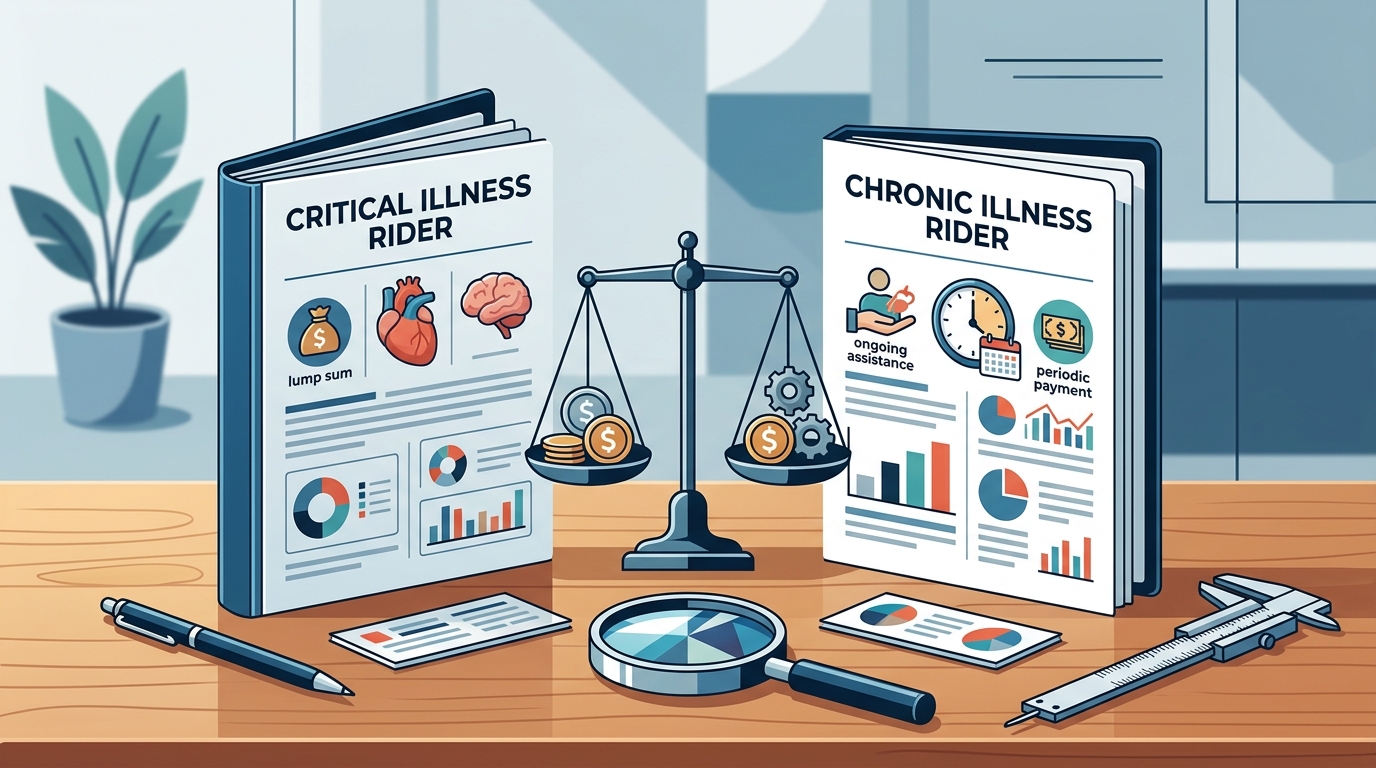
Comparison Table
The following table summarizes the core differences between critical illness and chronic illness riders to help you make an informed decision.
| Feature | Critical Illness Rider | Chronic Illness Rider |
|---|---|---|
| Trigger Event | Diagnosis of specific severe conditions (e.g., cancer, heart attack) | Inability to perform ADLs or severe cognitive impairment |
| Payout Structure | Lump-sum payment | Monthly or periodic payments |
| Primary Use Case | Covering immediate medical and non-medical costs of acute events | Covering long-term care and daily living expenses |
| Typical Beneficiary | Younger individuals or those with acute risk factors | Older individuals or those with degenerative risk factors |
| Duration of Benefits | One-time payment | Ongoing until limit or recovery |
Key Takeaways
- Living benefit riders allow access to death benefits while alive, providing liquidity during health crises.
- Critical illness riders pay a lump sum upon diagnosis of specific acute conditions like heart attack or cancer.
- Chronic illness riders provide ongoing payments for individuals unable to perform Activities of Daily Living.
- Trigger differences are critical: diagnosis vs. functional impairment.
- Payout structures differ significantly: lump sum vs. periodic income.
- Cost considerations vary based on age, health, and the likelihood of claims for each rider type.
- Professional guidance is essential to select the right rider for your specific financial and health profile.
Frequently Asked Questions
What is the main difference between critical and chronic illness riders?
The main difference is the trigger and payout. Critical illness riders pay a lump sum upon diagnosis of a specific acute condition. Chronic illness riders pay ongoing benefits for the inability to perform daily activities or severe cognitive impairment.
Can I have both critical and chronic illness riders?
Yes, many permanent life insurance policies allow you to attach both riders. This provides comprehensive coverage for both acute health events and long-term care needs. Contact us to discuss bundling options.
Are the benefits from these riders taxable?
Generally, accelerated death benefits are tax-free up to the amount of premiums paid. However, tax laws can change, and individual circumstances vary. It is recommended to consult a tax professional for advice specific to your situation.
How does accessing living benefits affect the death benefit?
Accessing living benefits reduces the death benefit available to your beneficiaries. The remaining death benefit is typically reduced by the amount withdrawn plus any accrued interest or fees.
What is an Activity of Daily Living (ADL)?
An Activity of Daily Living includes basic tasks such as bathing, dressing, eating, transferring, toileting, and continence. Inability to perform at least two of these typically triggers a chronic illness rider.
Do I need a long-term care policy if I have a chronic illness rider?
A chronic illness rider can serve as a cost-effective alternative to standalone long-term care insurance. It integrates care funding into your life insurance policy, potentially simplifying your financial portfolio.
How do I request a quote for these riders?
You can request a personalized quote by visiting our contact page or calling our office directly. Rachel Reynolds will help you evaluate your needs and recommend the appropriate coverage.
Next Steps
Evaluating your options for critical and chronic illness riders is a proactive step toward securing your family's financial future. Whether you are concerned about sudden health shocks or long-term care costs, having the right rider can make a significant difference. Rachel Reynolds is ready to help you navigate these complex decisions with clarity and confidence. Schedule a consultation today to explore your options and build a protection plan that works for you. Visit our home page to get started.